
Home » What Are the Risk Factors?
Genes play an important role in substance use disorder (SUD). Research with twins and adopted children shows that 40–60% of a person’s risk for SUD comes from their genetic makeup. Scientists are still working to identify the specific genes involved.
All addictive drugs affect the brain’s reward system. This system is meant to encourage behaviours that help us survive. For example, eating foods with fat, salt, or sugar can feel good because, long ago, these foods helped keep people alive. Drugs, however, skip the normal behaviour step and activate the reward system directly. They usually do this by acting on brain cells that release dopamine. Many drugs imitate natural chemicals in the brain, like endorphins (linked to opioids) or anandamide (linked to cannabis).
Some people’s reward systems are more easily affected by drugs. This can happen because of certain genes that make their brain receptors more sensitive. There isn’t just one gene involved—there are many—and they may or may not be passed down through families. This makes the science complex.
Genetic differences can shape many parts of a person’s experience with drugs, including:
For example, studies show that sons of fathers with alcohol use disorder often respond differently to alcohol than sons of fathers without the disorder. They may find alcohol more enjoyable and may naturally tolerate larger amounts.
A new program for schools, Preventure, developed by University of Montreal psychiatry professor Patricia Conrod identifies four main personality traits that put children at risk for SUD:
All of these traits are linked to mental health conditions with the exception of sensation-seeking. The program aims to determine which students have which traits and gives them coping strategies to manage these traits.
Families often notice that their loved one isn’t just struggling with substance use — they’re also dealing with deep emotional pain, anxiety, or other mental health conditions. It’s not always clear which came first, but the two often go hand in hand.
Sometimes, people use alcohol or other drugs to cope with overwhelming feelings — sadness, fear, stress, or trauma. This is called “self-medication.” It might help for a little while, but over time, substances can make those feelings worse. For example, someone with post-traumatic stress disorder (PTSD) may feel anxious all the time and turn to alcohol just to get through the day. But alcohol can actually increase anxiety and make recovery harder.
Certain mental health conditions — like depression, anxiety, attention deficit hyperactivity disorder (ADHD), bipolar disorder, or schizophrenia — can make someone more vulnerable to addiction. And some personality traits, like impulsiveness or difficulty managing emotions, are common in both SUD and mental health conditions.
Young people are especially at risk. Heavy substance use during the teen years can affect brain development and lead to long-term problems with mood, thinking, and relationships.
As a caregiver, it’s important to know that your loved one may be facing more than one challenge at once. Understanding this overlap — called “concurrent disorders” — can help you support them with compassion and patience. Recovery is possible, especially when both mental health and substance use are treated together.
Many people with addiction say their problems started when they were teenagers. The earlier someone tries alcohol or drugs, the more likely they are to develop serious problems later on.
Teen years are a time of big changes — in school, friendships, and brain development. If substance use begins during this time, it can disrupt how a young person grows, learns, and connects with others.
Drug and alcohol use in adolescence can affect memory, thinking, and emotional development. It can make it harder for youth to succeed in school or build healthy relationships.
For families, this means prevention and support are key. Helping teens avoid or delay substance use can protect their future and give them a better chance at a healthy, stable life.
Positive parenting plays a protective role in teen development. When parents stay involved by supervising, setting clear expectations, and keeping open communication, teens are less likely to engage in risky behaviors. The authoritative style of parenting—firm but supportive—usually leads to the best outcomes. Teens whose parents regularly discuss substance use are less likely to experiment with drugs or alcohol, showing that honest, ongoing conversations make a difference.
Parental substance use increases the risk for children, as youth are more likely to copy the behaviors they see at home. Siblings also influence each other; if an older sibling uses substances, a younger sibling is at higher risk, especially when they are close in age, the same gender, and share a warm relationship.
Family conflict, lack of routines, and weak family bonds further raise the risk of substance use. When families experience disharmony or disconnection, teens become more vulnerable to experimenting with alcohol or other drugs.
Trauma can greatly increase the risk of developing SUD. Research shows that the more severe and varied the stress a child experiences, the higher their chances of struggling with addiction later in life.
The Adverse Childhood Experiences (ACE) study found strong links between early trauma and addiction. ACEs include emotional, physical, or sexual abuse; neglect; growing up with a parent who has a substance use or mental health condition; losing a parent through death or divorce; living with domestic violence and having a parent who is incarcerated.
The impact is striking. Children with four or more ACEs are five times more likely to develop a problem with alcohol and 60% more likely to become obese. Men with six ACEs are 46 times more likely to inject drugs compared to those with no ACEs.
Trauma doesn’t only happen in childhood. Adults can also face experiences that raise their risk for addiction and mental health challenges. PTSD can develop from events such as combat, emergency response work, or violent assaults. Sexual or physical assault can also increase vulnerability to SUD.
For family caregivers, understanding trauma is key. Trauma doesn’t guarantee addiction but it makes people more vulnerable. Recognizing these risks helps families respond with compassion, support, and advocacy for trauma‑informed care.
Young people start using substances for many reasons, but peers play a major role. During adolescence, friendships become central and often shape choices around risk‑taking and identity. Peers provide support, a sense of belonging, and encouragement for exploring new experiences, including romantic relationships and sensation‑seeking behaviors.
Alcohol, tobacco, and other drugs are most often tried for the first time in adolescence, with use increasing through middle and high school and into young adulthood. Friends create the social setting where substance use begins and grows. One of the strongest predictors of cannabis use is how much an adolescent’s friends are using it themselves.
Religiosity plays an important role in whether young people develop SUD. Studies show that having strong religious or spiritual beliefs, and seeking guidance from faith, can lower the risk of substance use for both teens and adults.
Social influences also matter. Family, school, and peers are the main places where behaviors are learned. Disorders such as antisocial personality disorder, conduct disorder, and oppositional‑defiant disorder often appear alongside SUD. These conditions can make it harder for children and teens to read social cues and build confidence, which increases the chance they will start using drugs earlier, use more heavily, and be more than twice as likely as their peers to develop an SUD.
Social isolation is another major risk factor. Isolated teens process risk and reward differently, making them more sensitive to the “reward” of drugs. Research shows that both social connection and drug use activate similar pathways in the brain, which means drugs can feel like a substitute for belonging. As Johann Hari has said, the opposite of addiction is not sobriety—it is connection.
Healthy socialization can protect against drug use, but not all social experiences are positive. Early experiences of bullying or negative peer influence can increase later drug use. For caregivers, encouraging safe, supportive social connections is one of the most powerful ways to reduce risk.
The dependence potential of a drug varies from substance to substance, and from individual to individual. Dose (potency), frequency of use, pharmacokinetics (the characteristic interactions of a drug and the body in terms of its absorption, distribution, metabolism, and excretion), route of administration (swallowing, snorting, smoking or injecting) and duration of use are critical factors for developing drug dependence.
A Lancet article compared the harm and physical and psychological dependence of 20 drugs, using a scale from zero to three for physical dependence, psychological dependence, and pleasure to create a mean score for dependence. Selected results can be seen in the chart below.
| Drug | Mean | Pleasure | Psychological Dependence | Physical Dependence |
|---|---|---|---|---|
|
Heroin |
3.00 |
3.0 |
3.0 |
3.0 |
|
Cocaine |
2.39 |
3.0 |
2.8 |
1.3 |
|
Tobacco |
2.21 |
2.3 |
2.6 |
1.8 |
|
Barbiturates |
2.01 |
2.0 |
2.2 |
1.8 |
|
Alcohol |
1.93 |
2.3 |
1.9 |
1.6 |
|
Benzodiazepines |
1.83 |
1.7 |
2.1 |
1.8 |
|
Amphetamines |
1.67 |
2.0 |
1.9 |
1.1 |
|
Cannabis |
1.51 |
1.9 |
1.7 |
0.8 |
|
Ecstasy |
1.13 |
1.5 |
1.2 |
0.7 |
Here is the comprehensive diagram illustrating the results for all 20 substances in terms of harm to self and harm to others.
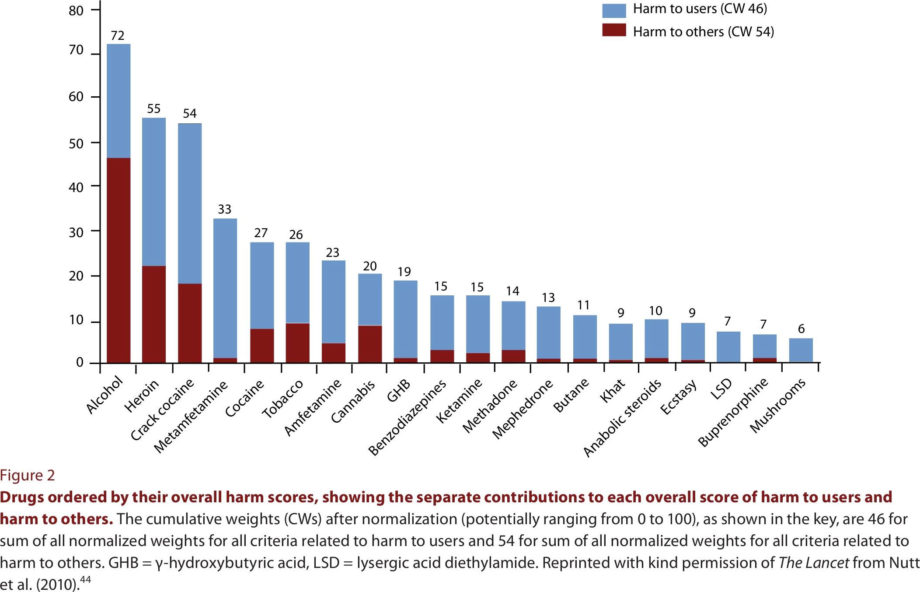
Wood E, McKinnon M, Strang R, Kendall PR. Improving community health and safety in Canada through evidence-based policies on illegal drugs. Open Medicine. 2012;6(1):e35-e40.
Regarding the harm each drug causes, heroin, crack cocaine, and methamphetamine are the most harmful drugs to individuals, whereas alcohol, heroin, and crack cocaine are the most harmful to others. Overall, alcohol is the most harmful drug with heroin and crack cocaine in second and third places.
The following chart on Addictive Qualities of Popular Drugs illustrates the dangers of six different drugs based on five criteria, being:
Withdrawal: Presence and severity of characteristic withdrawal symptoms.
Reinforcement: A measure of the substance’s ability, in human and animal tests, to get users to take it again and again, and in preference to other substances.
Tolerance: How much of the substance is needed to satisfy increasing cravings for it, and the level of stable need that is eventually reached.
Dependence: How difficult it is for the user to quit, the relapse rate, the percentage of people who eventually become dependent, the rating users give their own need for the substance and the degree to which the substance will be used in the face of evidence that it causes harm.
Intoxication: Though not usually counted as a measure of addiction in itself, the level of intoxication is associated with addiction and increases the personal and social damage a substance may do.
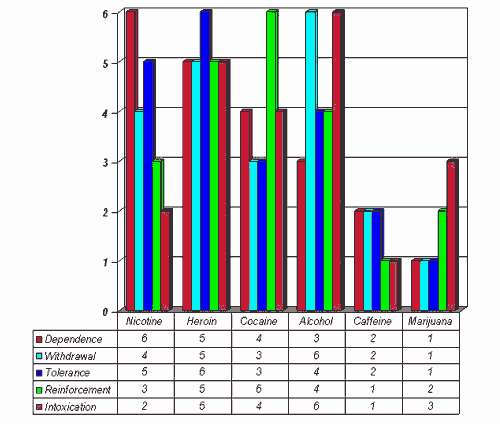
Source: Jack E. Henningfield, PhD for NIDA, Reported by Philip J. Hilts, New York Times, Aug. 2, 1994 “Is Nicotine Addictive? It Depends on Whose Criteria You Use.”
http://www.nytimes.com/1994/08/02/science/is-nicotine-addictive-it-depen…
http://www.erowid.org/psychoactives/addiction/addiction_media1.shtml
A significant percentage of the population is addicted to nicotine (14.6% from Tobacco Use in Canada: Patterns and Trends, 2015 Edition) but it rarely hijacks someone’s life. What makes nicotine the most addictive drug, but not the most impairing? Although nicotine is very addictive, it does not intoxicate or reinforce itself as much as other substances.
The faster a drug reaches your brain, the higher the risk of addiction. The fastest way for a drug to reach your brain is if you smoke it, then if you inject, snort or swallow it, in that order. The method used to consume a drug is called the “route of administration”. Some drugs affect the brain within seconds of use. Drugs that are smoked or injected reach the brain very quickly and result in an intense but short-lasting high. These drugs are highly addictive and include methamphetamine, cocaine, crack cocaine and opioids.
Some drugs are particularly addictive because they result in severe withdrawal symptoms if stopped. Prolonged use of a drug can lead to tolerance, or a lessening of the drug’s effects due to changes in the brain. Tolerance is a sign of physical dependency on a drug, meaning that withdrawal symptoms will be experienced if the drug use is discontinued. It is important to note that physical dependency and addiction are not the same thing; addiction has a psychological component that results in a compulsion to use a drug and cravings for the drug even in the absence of withdrawal symptoms. However, drugs that result in severe withdrawal symptoms can be among the most addictive, as the unpleasant symptoms of withdrawal encourage continued use (reinforce consumption).
For drugs that quickly leave the bloodstream, like cocaine, withdrawal symptoms can appear within hours. These symptoms often include depression, anxiety, and a craving for the drug. If these feelings are strong enough, they can drive a person to continue using the drug despite significant adverse consequences—the definition of addiction.
There are a number of factors that determine the addictive potential of drugs. Some of the most addictive drugs are nicotine, fentanyl, crack cocaine, cocaine, alcohol, methamphetamine, crystal meth – all of which have severe withdrawal symptoms, and/or result in a quickly-developed tolerance.
Your donation helps us support families affected by addiction and those struggling with their substance use.
Please join us and sign up for our e-bulletins to get up-to-date information and to lend weight to our voice.
Spirituality